Exit, Not Capture: Who Really Threatens Freedom in the Age of Technology
Fascism is defined by the absence of exit. By replacing the left-right divide with a structural test of whether systems concentrate power or open doors, this piece argues that freedom isn't about who rules, but whether you can leave.
 Cato21 min read
Lately, a phrase keeps coming up in European debates: "tech fascism." The worry goes like this: engineers, founders and libertarians are building a world that answers to no one, and democracy is the thing they're coming for. A handful of famous names usually stand in for all of them.
It's a fair thing to worry about. But a list of villains isn't an argument. People come and go; the structures they build stay. So here's a simpler question to ask of any idea, political or technological: does it gather power in one place, or spread it out? Does it close the doors, or open them?
Ask it that way, and the map looks very different.
In short
- What makes a system tyrannical isn't who runs it. It's that you can't leave.
- Many small places, each free to choose, beat one big place choosing for everyone, for your wallet and your mind alike. Freedom is one thing.
- The basics get cheaper where building is free. And once making things is cheap, the real question becomes how easily value can flow between people.
1. What fascism actually was
Mussolini summed it up himself: everything within the state, nothing outside the state, nothing against the state. In practice that meant:
- a total state that reached into every part of life;
- the nation above the person;
- one leader, one party;
- no dissent, no free press, no opposition;
- business working for the state, which Mussolini called corporatism;
- and above all, no way out.
That last one is easy to forget, and it's the one that matters most. A system becomes total when nobody can leave it.
2. Two ways to deal with a bad deal: speak up, or walk away
The economist Albert Hirschman noticed that when something isn't working for us (a company, a club, a country), we have two moves. We can speak up and try to change it. He called that voice. Or we can leave for something better: exit. Healthy societies need both.
Put those together and you get a simple picture of freedom:
- You're in charge of your own life: your body, your mind, your work, what you own.
- Communities can choose how they run themselves. A Swiss canton with direct democracy, a small monarchy like Liechtenstein, a cooperative, a commune, a market town.
- Speak up inside, walk away between. Inside a community, people decide things directly instead of handing it all to professional representatives. Between communities, you're free to move.
- Leaving is the one thing nobody can take away. It's what turns a system from a cage into a choice.
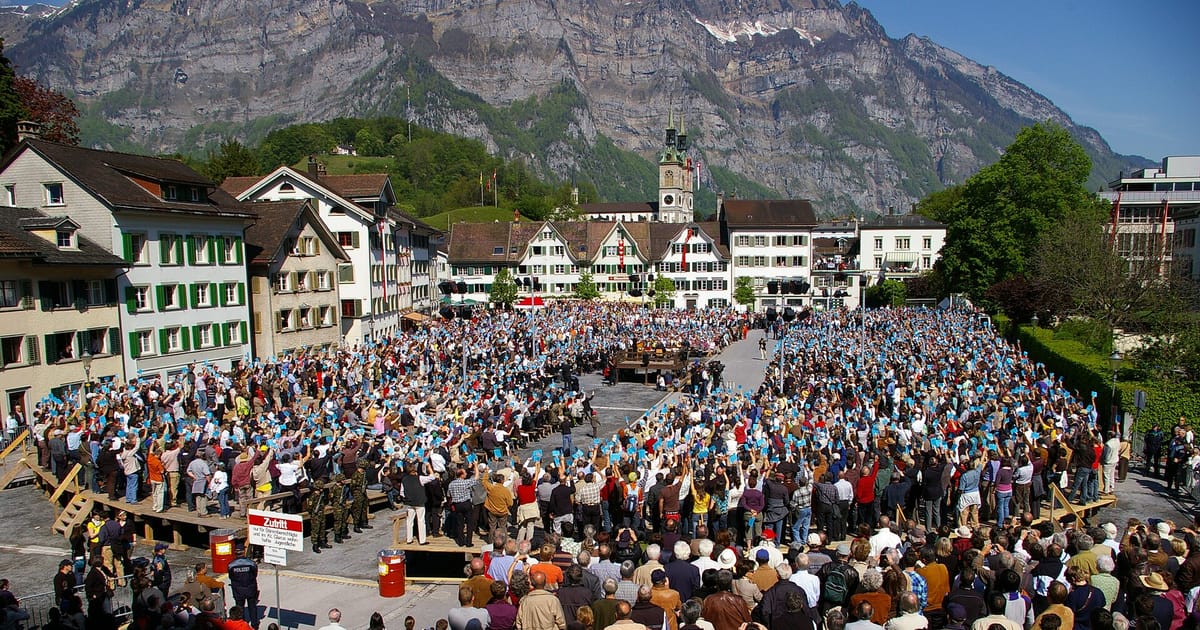
This isn't a fantasy. Switzerland has voted on national questions directly since 1848; Germany has never held a national referendum. In Glarus, people still vote on laws by raising their hands in the town square. And Liechtenstein's constitution lets its villages leave the country if they want to.
Vaduz Castle, home of Liechtenstein's prince, in a country whose villages have a constitutional right to leave. Photo: Jakub Hałun, CC BY 4.0.
3. Why many small places beat one big one
Decentralisation can sound like a technical preference. It's actually the most practical way to protect freedom, for four plain reasons.
Mistakes stay small. When one canton passes a bad law, one canton suffers, and everyone else gets to watch and learn. When a continent passes a bad law, there's nowhere to watch from.
Many experiments run at once. Twenty-six Swiss cantons try twenty-six slightly different answers to the same questions: taxes, schools, opening hours, building rules. The good ideas get copied, the bad ones quietly dropped. One central government gets one try, and it's very hard to admit when it failed.
The people closest to a problem know the most about it. Hayek's point, in The Use of Knowledge in Society (1945), was that the knowledge needed to run a society is scattered across millions of people and places. It can't be gathered into one office. Small units let decisions sit where the knowledge is.
Leaving keeps everyone honest. A government that can lose its residents has to behave more like a service and less like an owner. That was Hans-Adam II's argument in The State in the Third Millennium: the state as a service company competing for the people it serves. Leaving is feedback that can't be ignored.
Freedom is one thing
Here's the part that often gets lost. We tend to sort freedom into boxes: economic freedom (what you can build, earn, trade, rent out) over here, personal freedom (what you can say, believe, take, think) over there. Different parties claim different boxes.
But it's the same freedom, and it tends to be taken away by the same hands. A government powerful enough to decide what you may build and sell is powerful enough to decide what you may read and swallow. Small places let people choose the whole package together, and let you pick the package that fits you. Some will be stricter, some looser. That's the point: you get a choice, not a verdict.
And leaving only works if someone lets you in. Europe's migration systems are under real strain right now, and part of the reason is simple: when the legal ways to move don't match why people actually move, everyone gets squeezed through one narrow door that was never built for it. Communities that want newcomers, and newcomers who want to contribute, both deserve honest doors, opened by the communities themselves.
A total state versus many voluntary ones. One leader versus your choice of system. No way out versus leaving as a right. These aren't variations on a theme. They're opposites.
4. The best objection: "What about the basics?"
Every serious critic ends up here, and it deserves a serious answer. It usually goes something like this:
- Even in a democracy, whoever has the most money has the most say.
- Fine, let markets sell phones and cars. But homes, food and energy are necessities. Whoever controls those controls people.
- Besides, some markets are already monopolies. Competition is a fairy tale.
- And once robots do the work, the gains will go to shareholders. The rest of us won't see a cent.
Each of these sounds right. Each looks different once you check what actually happened.
Money buys influence, but only over what's for sale
Money does buy influence. The question is: influence over what? Lobbyists go where the power is. The more a central government can hand out (licences, subsidies, protected markets, exemptions), the more it's worth buying. A small canton that can't grant anyone a national monopoly isn't worth a lobbyist's time. A capital city that can is a gold mine.
So the answer to "money buys laws" isn't to give lawmakers more to sell. It's to keep decisions close to the people they affect, and keep the doors open, so a captured town simply loses its residents.
Homes: the trouble is building, and "protecting" the rent
Homes aren't expensive because markets refuse to build them. In most growing cities, it's simply not allowed to build enough of them.
Suginami, Tokyo. Japan's relaxed national zoning lets its biggest city keep building, and keeps rents far calmer than in most world capitals. Photo: Ximonic, CC BY-SA 4.0.
Auckland ran the experiment. In 2016 the city made it legal to build more homes on roughly three-quarters of its residential land. Researchers later found that construction jumped as a direct result, with tens of thousands of extra homes approved within five years, and rents grew more slowly than in similar cities. Nobody was nationalised. Building just became legal.
The other half of the story is the rules meant to protect tenants: rent caps, rent freezes, mandatory long leases. They do help the people who already have a flat. The bill goes to everyone still looking: the young, the newcomers, anyone who has to move for work. And the evidence keeps saying the same thing:
- Buenos Aires. A 2020 rental law imposed three-year minimum leases and once-a-year rent adjustments in a country with runaway inflation. Landlords pulled out: long-term listings roughly halved by 2023. When the law was scrapped at the end of 2023, listings on the city's biggest property site nearly tripled within a year, and rents fell after inflation.
- Berlin. The 2020 rent freeze did lower advertised rents, but the number of flats offered for rent dropped sharply, with researchers estimating some of them were lost to the rental market for good. Rents in neighbouring Potsdam took off. Germany's Constitutional Court struck the freeze down in 2021.
- Stockholm. Regulated rents, and a city housing queue of almost 900,000 people. The average wait for a regular lease is about nine years; for central Stockholm it has been closer to eighteen.
- San Francisco. When rent control was extended to more buildings in 1994, affected landlords cut their rental supply by about 15%, converting to condos or redeveloping, which pushed rents up across the city by around 5%.
A rule that makes renting out a flat a bad deal doesn't create homes. It creates queues. Let people build and rent, and supply catches up. That's not a theory about greed. It's arithmetic.
Hard to beat isn't the same as forbidden
Some companies really are bottlenecks. Nvidia dominates AI chips. Further up the chain is a monopoly most people have never heard of: ASML, a Dutch company, is the only one on Earth that builds the EUV machines used to print the most advanced chips. It shipped 48 of them in 2025, with about €39 billion of orders waiting. (Substrata, an open research project that maps these chokepoints, rates it 12 out of 12.)
But notice what's not happening. Neither company stops anyone from competing. They got where they are through ingenuity, smart investment, and getting thousands of brilliant people to pull in one direction. Anyone can try to build a rival machine. Canon is working on a different printing method that skips EUV entirely. It's just extraordinarily hard.
The monopolies worth worrying about are the other kind: the ones protected by licences, tariffs and rules that make competing illegal or impossible. A market monopoly lasts until someone builds something better. A protected one lasts until the law changes.
Robots and shareholders: we've been here before
The fear that machines will only make their owners rich is old. People said it about the power loom, the tractor and the steam shovel.
A steam shovel at work on the Panama Canal. Machines like this replaced armies of diggers and made canals, foundations and roads affordable for everyone. Public domain.
The companies that made excavators did make money. But they competed with each other, and so did the builders who bought them, and the savings flowed down to everyone paying for roads, homes and canals. Nobody managed to keep the excavator to themselves.
Food tells the same story. In 1960, Americans spent about 17% of their disposable income on food. By 2025 it was 9.7%, while eating more, and more varied, food than any generation before. Machines, logistics and competition did that, not a ration office.
The next round is already visible: robotic farms, self-driving trucks moving food at night, automated warehouses. Gains stay stuck with shareholders only when competitors are kept out, and keeping competitors out at scale is something only governments can really do. If one licensed robotics company is allowed and everyone else is barred, worry. If anyone can build robots, consumers win, like with every machine before.
Energy: the most tangled bottleneck of all
Energy is still a real constraint, and it's one of the most heavily regulated markets there is. New nuclear plants take a decade or more to approve. Connecting to the grid can mean years in a queue. Small modular reactors could let a town or a valley run its own power, about as local and independent as energy gets, if the paperwork let them be built as fast as they can be made.
The pattern repeats across homes, food and energy: where building is free, the basics get cheaper. Where it's blocked, they become the scarcity that markets then get blamed for.
5. When making things gets cheap, sharing becomes the problem
Follow that trend forward. Robots, AI and cheap energy are pushing the cost of making things toward zero: food, software, design, advice, even a lot of physical work. The hard question of the coming decades isn't whether there will be enough. It's how value gets from the people who create it to the people who need it.
Today that flow is surprisingly clumsy. Sending money across a border costs fees and days. Supporting someone's work means going through a platform that takes a cut and can switch you off. Lending to a friend's project, investing in a neighbour's business, or paying a stranger who helped you online all involve banks, paperwork and permission.
The old answer to "how do we share" is central redistribution: collect everything in one place and hand it back out. But that's capture again, with all its problems: one place deciding, one place to lobby, no way out.
The decentralised answer is to make sharing value as easy as sharing a link. That's what OrangeCat is for: anyone, under their real name or not, can sell something, offer a service, fund a project, lend, invest or simply support someone, in Bitcoin or whatever currency they use, straight to their own wallet. When creating gets cheap, the most important infrastructure is the kind that lets value move freely between people, without a gatekeeper in the middle.
6. Build, don't capture
There are two ways to change a big, stuck system.
Capture means taking it over and running it differently from the top. Revolutionaries and strongmen share this instinct, and it tends to end the same way: the concentrated power outlives whatever good intentions grabbed it.
Building means creating alternatives people can choose: open-source software, Bitcoin, encryption, open AI models, voluntary communities, new institutions that compete with old ones. Building spreads power out. It needs nobody's permission, and anyone who likes the old system can keep it.
The US Department of Government Efficiency, better known as DOGE, is a good case study. It set out to make waste and theft technically harder with modern systems, payment controls and simpler services. Its most visible result is America.gov, launched in September 2026 and built partly by former DOGE engineers: one front door to federal services that used to be scattered across dozens of agency websites. Critics have fair points too: some savings claims were overstated, and its access to sensitive citizen data ended up in court. But the bigger lesson is about method. Even with enormous political backing, changing things from the inside was slow, contested and partial.
Building outside is also how voice gets better, not just exit. Solon is an attempt at governance you can check instead of having to trust: votes are cryptographically signed, the shared treasury is visible on-chain, and decisions are tracked against the goals they were supposed to meet. And Loki is where the actual building happens: a workspace for running projects, people, money and AI agents, so small teams can ship things that used to need big organisations.
Disclosure: OrangeCat, Solon, Loki, Substrata and DiploDoctor are projects by the author of this piece.
7. The smallest jurisdiction: your own mind
If leaving matters for countries and companies, it matters most for the one place you can never move out of: your own head. Freedom of mind isn't a separate topic. It's personal freedom at its smallest and most intimate scale. The idea has a name, cognitive liberty: the right to decide for yourself what happens in your own consciousness. And it was born in an unexpected place, the world of psychedelics.
Albert Hofmann, who discovered LSD at Sandoz in Basel, photographed in 1993. Photo: Philip H. Bailey, CC BY-SA 2.5.
The history is a neat summary of everything above. LSD was first made in 1938, and its effects discovered in 1943, by Albert Hofmann at Sandoz in Basel, a private company. He isolated psilocybin there too, in 1958. Then governments banned them, the US in 1970 and the UN in 1971, and serious research into depression and trauma stopped for decades. It came back largely because private donors and small nonprofits kept funding it.
But the people who kept these traditions alive were never waiting for permission. Ceremonies carried on outside any official framework, and for many people (plenty of them sensible adults who knew exactly what they were choosing) those nights were among the most meaningful of their lives. Now that psychedelics are going mainstream, the risk runs the other way: that "safe access" ends up meaning a few licensed, expensive, commercial providers, with everyone else shut out. That's the protected-monopoly problem from section 4 again, just with mushrooms.
There are bad facilitators, of course, just as there are bad doctors and bad priests. The best protection is the same one that works everywhere else: honest information, word of mouth, and the freedom to walk away. People who study psychedelics, like the anthropologist Nicolas Langlitz, keep finding that these substances don't push anyone toward a particular politics. Who you are and where you are matter more. Technology works the same way. Tools amplify what people bring to them. What matters is whether people are free to choose them.
The same goes for knowing your own body. Your health data is about as personal as information gets, yet most people can barely read their own lab results without an appointment. DiploDoctor reads a lab report with you: every value, which ones are out of range, what to ask. It works with whichever AI model you choose, and, when you want a person, with a professional you pick yourself.
And the question is about to get bigger. Millions of people now think out loud with AI systems that log every word. Whether those tools stay private, open and under your control, or end up centralised and watched, is the cognitive-liberty question of this decade.
8. "TESCREAL": one label for two enemies
A popular label in this debate is TESCREAL, coined by Timnit Gebru and Émile P. Torres. It stands for Transhumanism, Extropianism, Singularitarianism, Cosmism, Rationalism, Effective Altruism and Longtermism, and it's used to describe the shared worldview of "tech oligarchs."
The trouble is that it lumps together people on opposite sides of the biggest tech fight of our time. Rationalists and many effective altruists are the loudest voices for slowing AI down: pauses, licences, strict rules. Accelerationists want the opposite. A label that covers both sides of the field's main argument doesn't explain the field. It flattens it.
There's a history problem too. Some of the earliest thinkers in this tradition, like J.D. Bernal and J.B.S. Haldane, were Marxists, and Russian cosmism fed into early Soviet science and ambition. The dream of improving the human condition with technology has never belonged to one side of politics. The real question is who controls the technology: a state, a monopoly, or everyone.
9. A quick context check
Because this debate so often runs through a few famous names, it's worth checking the most-quoted lines against what was actually said. Context doesn't settle every argument, but it should come before the verdict.
Peter Thiel, 2009. In an essay called The Education of a Libertarian, he wrote that he no longer believed freedom and democracy were compatible. The same essay included a widely criticised remark about who gained the vote, which he later clarified: he doesn't think anyone should lose it. What almost nobody quotes is his conclusion: escape, not takeover. He pointed to the internet, space and new ocean communities as places to build freer arrangements.
Peter Thiel, 2014. "Competition Is for Losers" was the headline of an essay promoting his book Zero to One. It's business advice: build something new enough that, for a while, nobody else does it. That's the Nvidia and ASML story above, not a defence of monopolies protected by the state.
Curtis Yarvin. His best-known idea, Patchwork (2008), imagines many small, independent territories competing for residents who are free to leave. He has also argued for strong executive rule in the US as a transition. The fair criticism is that his model is all exit and no voice: no democracy, even locally.
Elon Musk, 2025. On The Joe Rogan Experience he called empathy the fundamental weakness of Western civilisation. In the same conversation he said he believes in empathy, but that it's being exploited, and borrowed Gad Saad's phrase "suicidal empathy": compassion that cares more about looking kind than about what actually happens, and ends up hurting the people it means to help. You can disagree with how he applies it. But "empathy is bad" isn't what he argued.
In every case the quote is real, and the fuller picture is more interesting, and more arguable, than the slogan.
10. Where we agree, and where we don't
The left and decentralists agree on more than either likes to admit:
- Crony capitalism is rotten. Companies using the state for protection, subsidies or monopolies are a problem.
- The state can be a tool of domination. Marx also expected it to wither away.
- Your mind is your own. No government should decide what you put into it.
- Representatives who answer to no one are a problem. Swiss-style direct democracy is hard for either side to argue against.
The real disagreement is about where domination comes from. The left says markets concentrate power, and the right to leave means little if you can't afford to. The decentralist answer is that states concentrate power more reliably than markets do: you can leave a company, but rarely a country. And the basics have got cheaper fastest where people were free to build, trade and share, not where one office decided for everyone. No central authority can know enough to steer a whole society. Not a state, not a party, and not a tech CEO either. Which is exactly why nobody needs to be humanity's saviour.
11. The question
In a decentralised world, anyone can start a commune, share everything, and live by socialist principles. Nobody can stop them.
In a centrally planned world, can anyone start a market?
That's the real line. Not left versus right, not technology versus humanity, and not one billionaire versus another. Exit versus capture. A choice of systems versus one system for everyone. And it's a good question to ask of any political project, on any side: does it leave the doors open?
Sources and further reading
- Albert O. Hirschman, Exit, Voice, and Loyalty (1970)
- F.A. Hayek, "The Use of Knowledge in Society," American Economic Review (1945)
- Hans-Adam II, The State in the Third Millennium (2009)
- Greenaway-McGrevy & Phillips, "The impact of upzoning on housing construction in Auckland," Journal of Urban Economics (2023)
- IZA Discussion Paper 18107 on the end of rent control in Argentina (2025); Zonaprop listing data via Reason (2025)
- Hahn, Kholodilin, Waltl & Fongoni, "Forward to the Past: Short-Term Effects of the Rent Freeze in Berlin," Management Science (2024)
- Stockholm Housing Agency (Bostadsförmedlingen), queue and waiting-time statistics
- Diamond, McQuade & Qian, "The Effects of Rent Control Expansion on Tenants, Landlords, and Inequality: Evidence from San Francisco," American Economic Review (2019)
- USDA Economic Research Service, food spending as a share of disposable personal income (1960–2025)
- ASML annual results 2025; Substrata: EUV lithography scanners
- Nicolas Langlitz, "Rightist Psychedelia," Cultural Anthropology (2020)
- Timnit Gebru & Émile P. Torres, "The TESCREAL bundle," First Monday (2024)
- Reporting on America.gov's launch, September 2026 (Nextgov, GovExec, Washington Technology)
- Peter Thiel, "The Education of a Libertarian," Cato Unbound (2009); "Competition Is for Losers," Wall Street Journal (2014)
- Mencius Moldbug (Curtis Yarvin), "Patchwork: A Political System for the 21st Century" (2008)
- The Joe Rogan Experience, 28 February 2025; Snopes fact-check of the empathy quote; Gad Saad, Suicidal Empathy (2025)
Cover image: Landsgemeinde in Glarus, 2009. Marc Schlumpf (icarus-design.ch), CC BY-SA 3.0, via Wikimedia Commons.
Discussion
Sign in to join the conversation.